https://twitter.com/BarbaraDaniels6

Showing posts with label Usk plaques. Show all posts

Saturday, 19 March 2016

A mini-walk near the Usk


A short stroll
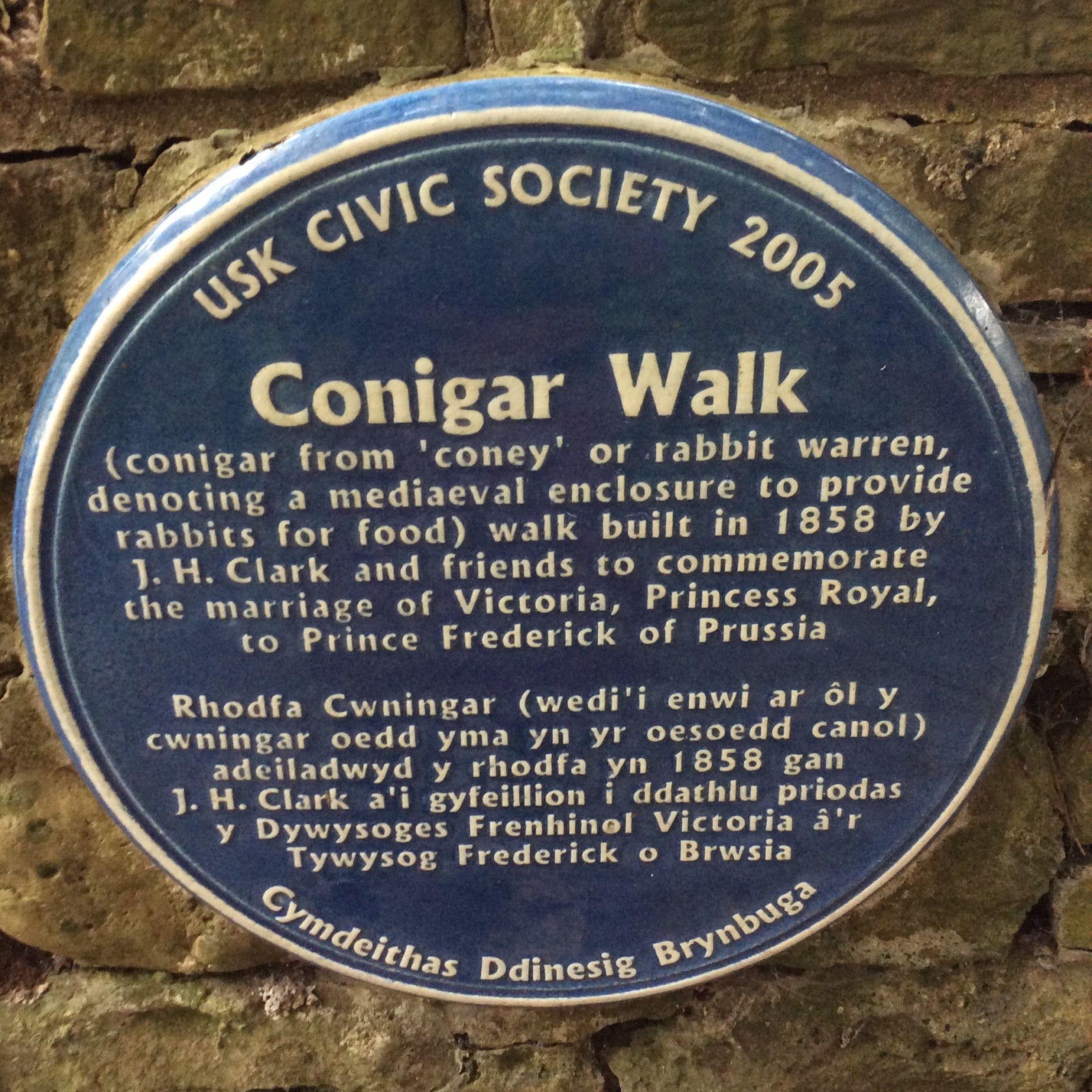
   A few minutes' walk from the bus station down the Abergavenny Road in Usk is a turn-off to the left through an iron swing gate. This is Conigar Walk whose history is told here and it leads to the river Usk. It is unusual for a town to have the same name as its river: more common would be Talybont-on-Usk for example.

A living larder
   Rabbits (or coneys) were kept in enclosures to provide some of the food for the garrison and owners of Usk Castle. They would also eat salmon and lampreys from the river as well as eggs and pigeon squabs from the loft in the castle (columbarium). The couple whose marriage was commemorated by the building of this walk in 1858 by J. H. Clark and friends later became the parents of 'Kaiser Bill' of the First World War.

A linguistic tip
  Although this is not a particularly Welsh-speaking area, signs are bilingual and here you can see a feature of the Welsh language which is worth noting. The initial "P" of "Prussia" becomes "B" in "Brwsia", a process known as mutation which makes use of a dictionary tough for learner. It follows strict grammatical rules governing the change of one initial letter to another but helps the sound and makes for fluent speech - in time!

Tuesday, 15 March 2016

Usk park


Somewhere quiet to picnic
   This plaque tells of the history of the park which is a short walk from the Usk bus stops in Twyn Square and children can play whilst you lounge here as well as taking a look at the wild flower garden dedicated to Jane Hathaway. Brynbuga is the Welsh for Usk and the final part can be pronounced "beega" so as not to sound rude.

Possible Roman connection
   During the 1960's and 1970's excavations in Usk revealed the remains of two groups of granaries used to store the provisions needed to feed the Twentieth Roman Legion whilst it was stationed in Usk. Since these foundations were of wood, they were covered over again to avoid rot and it is difficult to find out where they were. Some knowledgeable local residents believe they may have been here, in this field, and say there interesting remains of occupation under the grass. If you Google the excavations you will see a photograph showing how huge these stores were by comparison to the diggers working on them. However, the size of the site suggests to some historians that the granaries were in the field behind the Sessions House. Later, because of flooding in Usk, the soldiers were moved to Caerleon.