https://twitter.com/BarbaraDaniels6

Showing posts with label Matilda. Show all posts

Sunday, 19 March 2017

Richard Strongbow de Clare - and family

Chepstow Castle (Striguil)
   The de Clare family was rich, powerful and extremely prominent in the Welsh Marches of Medieval times and one of the most interesting of them was Richard Strongbow. Confusingly (and I sometimes feel it was done deliberately in order to muddle me!) they called alternate eldest sons Richard or Gilbert.
   The Richard who interests us at this moment was nicknamed Strongbow - but so was his father! Despite the tendency at this period to accord a cognomen that commented on some physical peculiarity (Rufus, Wryneck or Curthose - short arse  - springs to mind) neither of these men seems to have had oddly shaped legs.
The nickname was probably a mistranscription in a Latin entry in the Domesday Exchequer annals of the early 14th century which appended the word "Stranghose" to his given name. The chronicler thought this meant "foreign leggings" but it probably referred to Striguil (Chepstow) which could also be spelled Strangboge, Stranboue or Stranbohe. Clear? No, neither am I, but this nickname stuck from then on.

  He was born in 1130 in Tonbridge, Kent, and died on 20th April 1176, aged 45/6, in Dublin, having been master of Chepstow, planner of Usk town and Governor of Ireland. Gilbert I (they are often given Roman numerals because of the problem we have noted) and his brother Roger had been part of the hunting party when William Rufus was killed - or murdered - and were brothers-in-law of the man who did the shooting, Walter Tirel. Whether or not they were part of a plot, they were rewarded by Henry I (who claimed the throne in indecent haste) with extensive grants of lands throughout England and Wales. Male members of the family made judicious marriages until they were amongst the most powerful magnates of the kingdom.
   Our Richard succeeded to the lordship of Striguil, aged only 18, and supported King Stephen against Matilda for the last 5 years of his reign. The next Henry, Matilda's son, his new liege-lord, regarded him with suspicion and failed to confirm him in the important title of Earl of Pembroke. At that time, he was, as Orpen said "a man who, having been brought up to greatness, had fallen on evil days and who therefore was all the more ready to endeavour to repair his fortunes by a bold adventure in another country." This was the Norman occupation of Ireland.

 
  In August 1166, Dermot Mac Murrough, King of Leinster, was banished and later landed in Bristol with his followers to seek support from Henry II to recover his position.The King, who had designs on Ireland, gave him letters patent but Richard Strongbow was alone in offering military support - in return for promises to marry Dermot's daughter, Eva, and inherit Leinster after his death. (I will not trouble our heads with the variant spellings of all these names!) However, he did not go immediately and then Henry forbade the mission. Yet, since Strongbow was on the point of departure, he set off despite this prohibition and Henry seized Striguil. Richard landed in Waterford with 200 knights and 1000 light troops, some recruited in Gwent. They took Waterford and Dublin but Henry saw his own ambitions threatened by this success and did a deal with Richard who ceded some gains but kept Leinster. By August 1173, Henry trusted him enough to make him Governor of Ireland. At about this time the stone keep of Usk castle was built and the charter for its Priory was granted.

Usk Castle

   In 1189 his daughter, Isabella, married one of the most powerful and renowned men of the age, William, Earl Marshall of England, who strengthened both Striguil and Usk castles adding to the latter the dominating curtain walls. Strongbow's tomb is not local to Gwent despite such claims. He was described by Geraldus Cambrensis: "His complexion was somewhat ruddy and his skin freckled; he had grey eyes, feminine features, a weak voice and short neck. For the rest, he was tall in stature and a man of great generosity and of a courteous nature."
    He was also an ancestor of the American Bush political family.

To read more about his influence in Monmouthshire you can click on Chepstow Castle, Usk Castle or the planting of Usk Town. There is also a post about the illustrious William Marshal.

Wednesday, 12 October 2016

Matilda of Flanders - wife of William the Conqueror

Who was she?
   Matilda was high-born compared to William the Bastard and initially refused to marry him for that reason. The niece and granddaughter of Kings of France and descended from the Anglo-Saxon royal House of Wessex, she probably considered herself much superior to the illegitimate son of a lowly woman, Herleva, even though his father was a duke. The marriage also breached the rules of consanguinity, which were quite strict at the time, and required a dispensation from the Pope, Leo IX. She may also have previously been in love with Brictric, a great and charming thegn from England, who snubbed her offer of marriage.

   Stories of how William overcame her resistance vary and may be fictitious. Yet a common element is that he rode to where she was, (possibly to Bruges or to her father's house in Lille) pulled her about by her braids and battered her. Her father, Count Baldwin V, wanted to fight for her honour but she declared she would marry no-one but this ardent and violent pursuer. He was about 23 and she 20ish at the most.
  Much has been made of her short stature (because he was tall by contrast) as certain estimates put her height at about 4ft 2" but others at nearer 5ft. These measurement were taken when her skeleton was examined on different occasions and it may not have been complete. Certainly she was seen as diminutive, beautiful - and funky!

Her successes
   She bore William 9 or 10 children of whom 2 became kings: William II and Henry I. There is no record of illegitimate offspring born to William and amateur psychology suggests that the stain of bastardy and love for her kept him faithful. Certainly he had delivered terrible revenge on the town of Alencon for a jibe at his unmarried mother's family trade as skinners and tanners: he cut off the hands and feet of 32 men in public.
   Matilda contributed to the success of the Norman invasion by kitting out a ship, the Mora, mentioned at the end of the Ship List, and embellishing the prow with a figure of a small gilded boy holding a horn to his lips with one hand and pointing with the other towards England. (A similar image appears on the Bayeux Tapestry, once believed to be her project but now thought to be that of Bishop Odo of Bayeux.) This speedy vessel raced ahead of the others and caused panic on board but William calmly sat down to a huge breakfast washed down with spiced wine whilst waiting for the rest of his navy to come into view.
   They spent much of their marriage apart (but the number of children suggests they made good use of their time together!) and he showed his faith in her acumen and judgement by appointing her regent in Normandy, assisted by Roger of Montgomery, when he had to be absent in England to conquer us (and impose the French subjunctive) and to keep order once he had won at Hastings. This was a a role of considerable legal significance and she carried it out with aplomb: all ran smoothly under her control of what her husband had termed "a turbulent people, always ready to cause disturbances."


   A triumphal feasting was held at Fécamp's old monastery to celebrate William's victory at which the couple wore "splendid garments, interwoven and encrusted with gold" but the greatest ceremony for Matilda was her coronation as Queen of England on May 11th 1068. William's had been marred by a misunderstanding of the shouts from within Westminster Abbey and the consequent burning of nearby properties but hers was a success despite her lukewarm welcome in the kingdom. She was led into the Abbey, prostrated herself as a symbolic start of a new life, was anointed with holy oil, received a ring as emblem of her "marriage" to the state and was crowned. (Charters issued at the time reveal English and Norman names but, by 1086, a similar list is entirely French.) Three new phrases were incorporated to emphasise the importance of consorts. After that there were frequent grand occasions of "crown-wearings", propaganda for the new monarchy with Matilda styled as "regina."
  The education of her children, including the daughters, must be counted as one of her major successes. This task was undertaken thoroughly and with great seriousness. She and William ensured that the boys received the upbringing suitable for aristocratic males with riding, hunting, political theory and military training but both sexes were taught the "liberal arts" of reading and some Latin along with religious instruction: writing was sometimes neglected and Matilda herself signed with a flourished mark. Cecilia, who became a nun, was instructed by Arnulf of Chocques to extend her learning to understand rhetoric and logic. Adela also was a noted learned lady and contemporary references to the girls are few but all complimentary. The boys were tutored by Lanfranc who became Archbishop of Canterbury in 1070.

The downside
   Perhaps the most notable difficulty of her marriage was their difference of opinion over their eldest son, Robert Curthose (Short-Arse) which developed into deep trouble. According to Orderic Vitalis he was "talkative and extravagant, reckless, very courageous in battle, a powerful and sure archer with a clear, cheerful voice and a fluent tongue. Round-faced, short and stout, he was commonly nick-named 'fat-legs' and 'shorty-pants.'" Lovable to a mother! He may have formed part of the council to help Matilda as regent but he later became rivalrous: he led a rebellion and Matilda supplied him secretly with large sums of silver and gold to pursue this hostility. Her support for her son against her husband was shocking behaviour at that time and William was furious when he found out: she was never appointed regent again. A contemporary chronicler recorded her words of love and "tender affection" for her first-born which may have caused friction with William Rufus and Henry. Yet she refused William's instructions to stop sending him money and was not punished for her defiance: he must have loved her truly.
   As regent, she used her power to gain revenge over the man who had spurned her twenty years earlier. She ordered the seizure of Brictric's manor of Tewkesbury and deprived his town of Gloucester of its charter. Finally she had him imprisoned at Winchester where he died 2 years later.
  Although her endowments of religious institutions seem in her favour, some of her generosity towards them is somewhat suspect. She gave abundantly to La Trinité, which she had founded after the Pope had agreed to her marriage, but many of the foodstuffs came from England: in all her gifts were worth £650,000 in modern terms. Also she demanded treasure from Abingdon and then complained it was inadequate.
   There was a superstitious side to her character: there were rumours that she sent gifts to a hermit in Germany who then had a dream presaging ill fortune for Normandy. A happier forecast was that for the baby daughter of Queen Margaret of Scotland, who pulled Matilda's veil down over herself at her christening, an omen later interpreted as a royal future for the child.
 
Death and legacy
    Her health must have deteriorated after July 1083 as, after a life of travelling, she never left Caen where she had helped a superficial reconciliation between her husband and eldest son. She died on 2nd November 1083. Opinions differ as to the date and cause of her illness but she probably drew up her Will in 1082: it is a rather impersonal document with bequests to La Trinité but includes, oddly amongst the expected finery, all a horse's accoutrements. These may have helped the Abbess on her travels but may have symbolised Matilda's peripatetic life. William organised a "most splendid funeral" at the abbey (contrasted again with the grotesque happening at his own when his corpse burst) and a beautiful monument with epitaph was erected which can still be seen at Caen. Later the "marriage" ring was found on her finger.
    After her death William mourned but became more tyrannical which suggests that, overall, she had been a softening influence. She established a model for female rule which made it easier for women to be appointed regent and use their power generally. Her bloodline extends to the present day in our monarchical family tree.

Relevance
   Wherever you ride on buses in Monmouthshire, you see through the window territory that William controlled - with some difficulty, appointing Marcher lords to subdue the hostile inhabitants. Behind him was Matilda, supporting him throughout, apart from the quarrel with Robert. Perhaps Chepstow Castle is the most obvious site, built by William fitzOsbern and added to by the Conqueror. Cherchez la femme!

My post on Chepstow Castle has links to many other castles in the area and you can read the story of William fitzOsbern by clicking here. There are many excellent CAKE opportunities in Chepstow, including by the River Wye.

Saturday, 17 September 2016

Ludlow Castle: from Conquest to Comus

Location and approach
   Ludlow is halfway along a line drawn from Bristol and Chester and on the course of the medieval road from Chester to Gloucester. The town and castle are situated on a ridge protected on 3 sides by rivers at the very centre of the Welsh March.
  As you approach the castle from the town - noting the absence of the usual chain stores as you go - you are looking over the fence to the Outer Bailey and a large lawn, at one time used as a tilt yard and later in WWII by American servicemen for baseball whilst the tower was a lookout post for the Allied forces.
  The original and more fascinating Norman castle lies beyond and comprises the Inner Bailey plus another innermost structure. Altogether it measures about 5 acres and has been described by English Heritage as "one of England's finest castle sites" and a "remarkably complete multi-phase complex."

Ownership
   Because of the long history of the castle and its involvement in many strifes and hostilities, it has changed ownership so many time that its vicissitudes would fill up this article. I will therefore summarise.
   Not mentioned as such in the Domesday Book, Ludlow Castle was probably founded by Walter de Lacy after the Conquest, circa 1075, as one of the first stone castles in England. During the 12th century war between Stephen and Matilda it became a pawn in the political game. The next most important owner was Roger Mortimer who acquired it in 1301 and whose family held it for over 100 years. Henry IV was the possessor when the war with Owain Glyndwr broke out.
   In 1425 Richard, Duke of York, inherited it and it became an important symbol of Yorkist authority during the Wars of the Roses, although it was more of a safe retreat than a central player. On his death it passed into crown ownership with Edward IV, 1461. Hosting the Council of the Marches of Wales, it became virtually the capital of Wales and, by the seventeenth century, was luxuriously appointed. It never quite recovered from the effects of the Civil War and the degeneration of the Council, although partial restoration and landscaping were carried out in the 18th and 19th centuries.

The Layout
  In the Outer Bailey are the Castle House, the Beacon Tower, the 16th century Porter's Lodge, prison, stable block and the 13th century Mortimer's Tower. The walls are linked to the medieval town walls and you will see different types of stone throughout ranging from Norman greenish-grey siltstone rubble to ashlar and quoin features carved from red sandstone.

The remains of the chapel

   The Inner Bailey has a gatehouse bearing the coats-of-arms of Elizabeth I and Sir Henry Sidney and 4 other towers. Passing through the gatehouse you will see the most striking feature: the 12th century chapel nave of St. Mary Magdalene, a circular Romanesque structure of sandstone inspired in design by the shrine at the Church of the Holy Sepulchre. It is very unusual, there being only 3 other examples in the country - such round churches are usually connected to the Templars. Here you will find also: the Solar block, the Great Hall, the Great Chamber block (the latter built by Mortimer and forming the popular tripartite arrangement of the 14th century), the kitchen, gardrobe (loo) block and Tudor Lodgings. The carved corbel heads may be Edward II and Queen Isabella.


Main events in order of importance - in my opinion
   Edward IV abolished the ancient office of Warden of the Marches and established instead, in 1472, the Court of the Lord President and Council of the Marches of Wales which became much more efficient in enforcing authority than the previous system. This dominated the district in which Mortimer had held power and Edward reinforced this by sending his eldest son, now termed Prince of Wales, to the castle in order to win the affections of the locals. The Council existed in some splendour until 1688 and had a number of dignitaries with imposing titles such as a Clerk of the Signet. After the Restoration it became corrupt and scandalous and was closed down by William III on 25th July 1689.
   Other residents were Edward, Prince of Wales, heir to Edward IV, and his mother in 1483 before Edward and his brother Richard were imprisoned in the Tower of London and vanished from the record. It was in Ludlow Castle that the young prince received the news on 14th April 1483 of his father's sudden death five days earlier.
   Prince Arthur (so named after King Arthur by his father) elder brother of Henry VIII was married at 15 to Catherine of Aragon first and went to Ludlow in 1501 for his honeymoon and to live in state before his death there.
   Walter de Lacy I original owner and builder was rewarded by William fitzOsbern, the Conqueror's right hand man, with 163 manors, 91 in Herefordshire alone but died by falling from scaffolding while superintending the building of St Guthlac's church in Hereford in 1085. This goes to show it does not pay to take too close an interest in construction projects.
   In the seige of  1139, the Beacon Tower was in legend the scene of an act of bravery and promptitude by King Stephen: a grappling hook had caught on the coat of the son of the King of Scotland, Henry, and would have hauled him off his horse into captivity but Stephen leaped to the rescue.
   Mary Tudor lived here for 19 months between 1525 and 1528 overseeing the Council of the Marches and a small sum of £5 was spend in restoration to prepare for her.

An exciting tale
   Son of another Hugh de Lacy, Walter, set off to reclaim Ludlow Castle but Joce de Dinan with 500 knights and archers plus loyal townsfolk fell upon them and drove them back. Joce himself pursued but was accosted by 3 knights and was in deadly peril. Enter his ward, Fulk le fitzWarin, who had been left behind in the castle, teased by Hawise, de Dinan's daughter, as a coward: protected by a rusty helmet and armed with a huge Danish axe, he rode to the rescue on a clumsy cart-horse. He cut through the skull of one knight and the backbone of the other. Joce sprang up and together they seized Walter de Lacy and the surviving knight Arnold de Lisle and imprisoned them in a castle tower.


   Joce was an unduly lenient jailor and allowed them to receive visits from the ladies of the household: Marion de la Bruere fell in love with the handsome de Lisle and helped them escape using a rope made of towels and napkins. Hawise married her hero but Marion, feigning illness, did not go with the bridal party to Hereford. She let her lover in through the same window of previous escape but de Lisle, with a friend, climbed a leather ladder to the trysting place with a different motive. Beneath were horsemen and foot-soldiers - and 100 men mounted up the ladder and threw the sentinel into the ditch. Marion learned of this at dawn and, overcome with remorse, killed her lover and jumped from the window, breaking her neck in the fall. The town was burned by the invaders and many inhabitants were massacred.
  This tale is unencumbered by too many dates (or facts?) and comes from only one source that I have found but it is a juicy one and I suspend any disbelief in excitement.

Less thrilling but important
   In 1634 at Michaelmas, Milton's masque Comus, was performed in the Great Hall for John Egerton, Earl of Bridgewater. It celebrates chastity, a virtue embodied in the Lady who debates it with her wicked captor, Comus. He would seduce her by any devious means if he possibly could. Yet, as Milton has said of chastity: "She that has that is clad in complete steel," and nothing untoward happens - unfortunately. Astute readers will have noticed that this statement is both untrue and sexist - though beautifully expressed.

Your visit
   Those same canny readers will also have perceived that you cannot get to Ludlow on a Monmouthshire bus but we are extending our microadventures by the train which goes regularly from Newport station through attractive countryside to Ludlow. For opening hours click here. There is an audio guide available and Ludlow is famous as a gastronomic centre with plenty of CAKE and other calorific opportunities.
   Another monument with many links to English history is Goodrich Castle.  Chepstow Castle and nearby Raglan Castle are both stunning and on Monmouthshire bus routes.
.


Tuesday, 30 August 2016

Goodrich Castle

Position
  Goodrich Castle is of Norman origin and is situated at a key location between Monmouth and Ross-on-Wye. Perhaps for this reason it seems to have been affected by the strife concerned with the English monarchy more than Welsh castles nearby, some of which had a relatively quiet time until the Civil War.
   Poised on the River Wye, near an ancient crossing point, its architecture was influenced by defensive needs and, once ruined, it became part of the itinerary of seekers after the picturesque. For some reason it now seems to me to be less famous than Raglan or Chepstow, although just as magnificent.
Construction
    It is possible that the earthworks around the castle were part of a hillfort dating from the Iron Age and the history of the castle itself begins with an entry in the Domesday Book of 1086 as belonging to Godric Mappeson, hence the name, Goodrich. Nothing of the probably wooden original survives. The area was part of the Welsh Marches, a group of territories granted to Norman nobles by William I to help keep the turbulent Welsh in order.
   The comparatively small keep (sometimes called Macbeth's Tower) in light grey sandstone is early Norman and had one smallish chamber on each floor measuring 18ft by 15ft (5.5 by 4.5 m) with thick walls and a mound around it for defence - the lower courses of stonework are still rougher than the rest. Around the keep is a virtually square structure guarded by 3 towers built during the 1280's from darker sandstone. These were protected on the vulnerable South and East sides by huge spurs which were intended to prevent undermining.
   In the 4th corner is the gatehouse where you enter, with one tower larger than the other and previously guarded by portcullises, murder holes and a drawbridge. Before you go into it you will cross the barbican which followed a similar design to that in the Tower of London and which had its own gate so that attackers could be trapped there. There is a chapel included here which was rare: the altar may have pre-dated the castle.
    The bailey had a number of luxurious large domestic facilities including a Great Hall, a Solar (living area from the French "sol"), kitchen, buttery (from French "bouteille") and pantry. The hall, overlooking the Wye had huge windows and fireplace. The living quarters were lavish as can be deduced from the unusual number of "garderobes" (latrines) for the comfort of inhabitants. We also know this from the detailed financial accounts of Joan, Countess of Pembroke and widow of William de Valence who would have had nearly 200 people to accommodate. There is a garderobe tower, unusually large, with the ultimate upper-class facility: multiple loos which could be used by several people at the same time. (You can see the outlets into the ditch from the East Wall.)  Beyond are the ruins of the stables destroyed in the Civil War.


    An example of good living: on Easter Sunday 1297, the kitchen ended the Lenten fast of the household with 3 quarters of beef, 3 pigs, half a boar, half a salmon, all from their store, half a carcass of beef at 10 shillings, mutton at 15 pence, 9 kid at 3s 8d, 17 capons, 2 veal calves, 600 eggs and more than 24 pigeons. Some banquet!

History
   

   Because of changes of ownership over the centuries, the various parts of the castle were built and added by different people. During the 1130's, the rival supporters of Stephen and Matilda were battling for power. William de Baderon, the next owner, (why is everyone in the period called William?) passed the castle on to his son, Baderon of Monmouth. He married into the de Clare family of the Stephen faction and had to seize the castle during the fighting. The de Baderons were a relatively poor family and perhaps could not afford to build some of the usual amenities. In about 1138 Stephen masterminded the transfer of Goodrich to Gilbert fitz Gilbert de Clare whereas the other nobles of Hereford supported Matilda. Later, Richard de Clare (Strongbow) lost the favour of King Henry II, son of Matilda, and the castle was taken into crown hands.
   In 1203, King John transferred the castle to William Marshal, one of the greatest knights of all times, who had to defend it from Welsh attack, particularly in a famous incident in 1216 when he was forced to leave Henry III's coronation banquet in Gloucester to rush back and fortify the castle. Although no documentary evidence survives, it is likely that he significantly upgraded its defences as he was a mighty castle renovator in Pembroke, Usk and Chepstow.
   William de Valence obtained the castle by marriage to Joan de Munchensi, becoming fantastically rich thereby but being obliged to enlarge the concentric castle at enormous expense, demolishing Marshal's construction, in order to defend it against the raids of Llywelyn ap Gruffudd into English territories. By the middle of the 1320's England suffered from the oppression of the Marcher lords, the Despensers, royal favourites of King Edward II. Hugh le Despenser kidnapped the then owner, Elizabeth de Comyn, in London and imprisoned her in her own castle in Goodrich. She signed it over but then married Richard Talbot who seized it back just before Queen Isabella, the "she-wolf of France", landed in 1326 and deposed the Despensers plus her husband Edward II (whose terrible murder she may have arranged.)
   Owen Glyndwr's forces invaded the Goodrich area in 1404 and 1405 but Gilbert Talbot fought back and the threat diminished in the 15th century which meant that the domestic aspects of the castle could then be expanded. During the Wars of the Roses the Talbots supported the Lancastrians but John died in their defeat in 1460 and the castle passed to the Yorkist, William Herbert, but later came back into Talbot possession to son John (by now we are confused by Johns!)

The Civil War

   
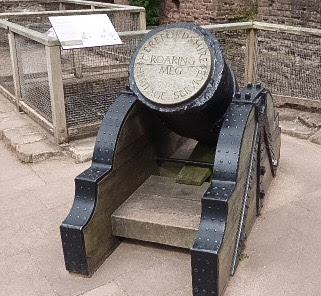
   One of the most bitter sieges of the Civil War took place at Goodrich: Richard Tyler, a local lawyer, had become tenant and constable of the castle and major renovations had been undertaken in the early 1630's. With his support the Earl of Stamford garrisoned the castle for the Parliamentary forces until December 1643 when it was occupied by the Royalist, Sir Henry Lingen,  whose troops of 200 men with 90 horses burned surrounding areas. In 1646, Colonels John Birch and Robert Kyrle, on the Parliament side, advanced from winning the Siege of Hereford and the struggle was increased by personal hatred between Birch and Lingen. Lingen set fire to the stables in the night but failed to win until later that year. He destroyed the water supply and ordered the building locally of "Roaring Meg", a massively powerful mortar capable of firing gunpowder-filled shells of 187-198 lbs in weight (85-90 kg.) This pugnacious lady now sits peacefully in the courtyard with an accessory of a pile of cannon balls nearby. Finally the Royalists surrendered having merely 4 barrels of gunpowder and 30 of beer left and marched out to the tune of "Sir Henry Lingen's Fancy". Their side left in style at Raglan also.

Comments
   In the early 16th century John Leland noted: ""They cary their prisoners to Castel Goderyce sumwhat owt of Erchynfeld, but longging to the Erle of Shrewsbyri." (Love that spelling!)  He was noting the fact that the castle was abandoned as a residence and was used for judicial purposes. Like many picturesque ruins, the castle attracted later sight-seers including William Gilpin who popularised the tourist craze in 1782 and who called the scene from the river one of the grandest views and "correctly picturesque", high praise from a man who wanted to take a mallet to Tintern Abbey to improve its appeal. Yet he managed to be grumpy about guidebooks: "full of intricate and tiresome details, and some undoubtedly incorrect."
   The early Victorian historian Theodore Fielding was moved to "solemnity that is inspired by the sight of grandeur sinking in dignity, into decay." Artists David Cox and William Callow visited and painted and William Wordsworth called it "the noblest ruin in Herefordshire", immortalising his visit in the 1798 poem: "We are Seven" inspired by meeting a little girl there. A window was added in the chapel in June 1992 to commemorate the personnel who died in service during the development of radar. RAF Halifax V9977 caught fire and crashed a mile south of the castle whilst flying a test mission in June 1942 killing all 11 on board. I feel this adds poignancy and modernity to the sense of past warfare.

A little extra
   In the early 1820's Sir Samuel Rush Meyrick wanted to buy the site but was refused: out of pique, presumably, he then built the neo-Gothic Goodrich Court next door, an act which greatly annoyed Wordsworth on his return visit since it spoilt the view. Personally, I'd love to have seen it. In fact, given a choice between a tour of Meyrick's folly and re-reading "We are Seven" ... The Court has been demolished but its gatehouse can be seen on the main road.

Your visit
  Arriving by the no 34 bus (Monmouth/Ross-on-Wye) may be less romantic than the river tour but the view of the castle as you approach still takes your breath away. There is a good shop, excellent café and toilets at the entrance (go before you go) and you can obtain a very helpful audio-guide free of charge. For prices and opening times click here. There are lovely walks in the area. Other interesting castles not too far away are Raglan Castle, Chepstow Castle and Usk Castle. Monmouth, at one end of your bus route has the castle where Henry V was born. I have merely summarised the fascinating history of Goodrich and will write in more detail about some of the people connected with it in future posts.